I’d like to start a topic here to explore what a TIDE curriculum should look like. How would its kodesh material differ from non-TIDE (or would it)? What about “chol” such as science or language arts? Mathematics?
Later today (bli neder), I’ll try to post a picture from R Schwab’s essay calling on KAJ to take the lead on putting this together.
I know that at the Frankfurt Lehrenstalt (Frankfurter Jeschiwo), they followed the “Preßburg” Derech. This is a bit of a misnomer, despite its association with Hungarian yeshivos, since it was the derech of the Chassam Sofer and, as such, the pre-Haskoloh Frankfurt derech halimmud. Here is a post from Treasures of Ashkenaz on R’ Breuer’s application of the Frankfurter Derech.
Rabbi Bechoffer posted something in the WhatsApp group a while back with some thoughts outlining how this might be approached. I think it’s a great initiative
The kodesh part of the TIDE curriculum would definitely place greater emphasis on chumash, navi, and halacha than the standard non-TIDE kodesh curriculum. (A Rebbe in a Yeshiva once pithily remarked that they dont teach Navi as they are a non-prophet organization). An ideal chol component would focus on understanding the world around us so that we can be better ovdei Hashem. The lessons would focus on understanding and using general chochma towards that purpose. The HS general studies curriculum currently being developed by Machon Menoras Hachochma in Baltimore and marketed throughout the US is a program in the right direction.
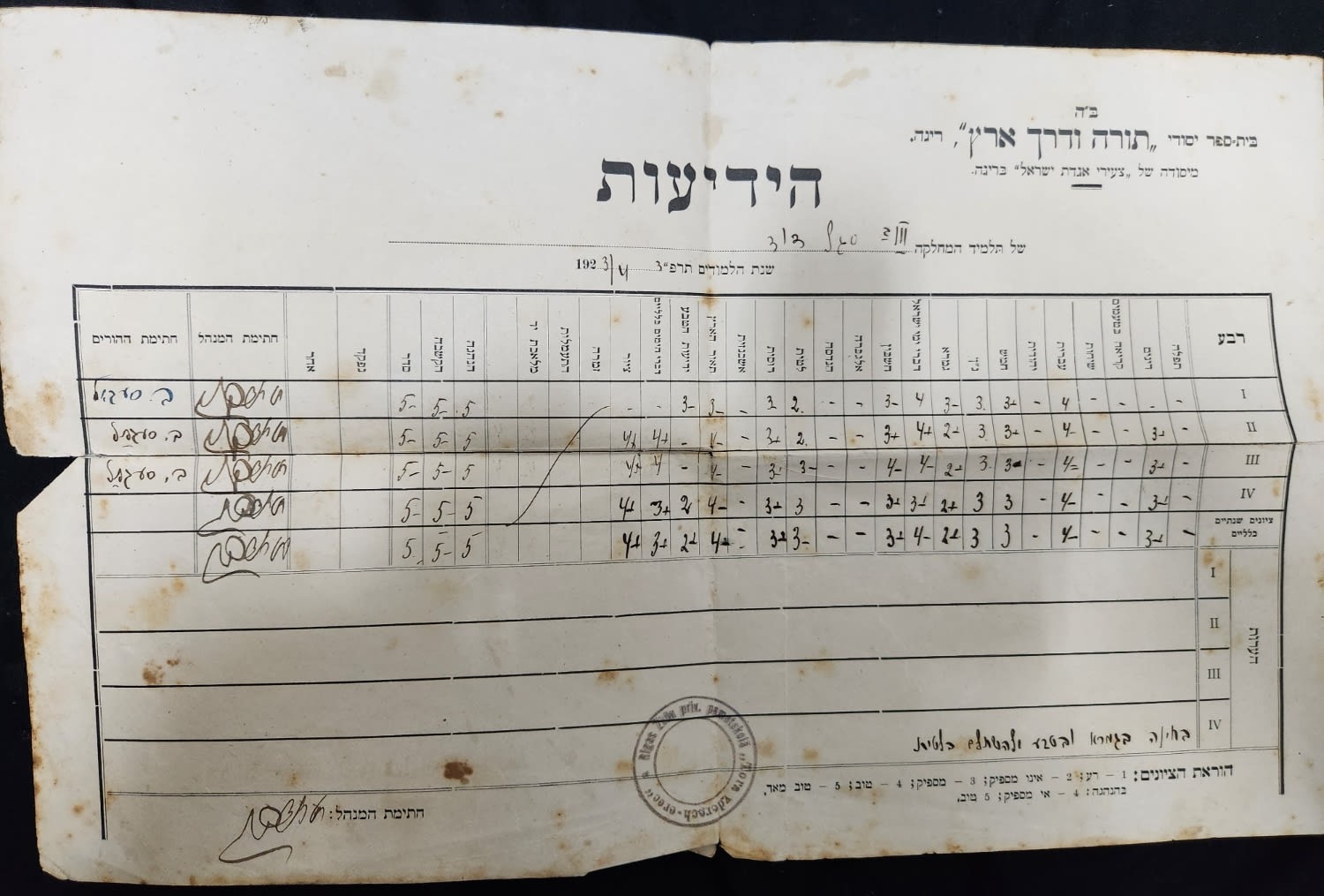
First, check out the report card that now serves as the banner for this site. The curriculum for the Telshe Yavneh system would also be an appropriate TIDE curriculum.
They appear to have learned multiple different languages, which is very interesting. They also generally had many different subjects- I imagine that based on that, there was not much time for any one. This is always the conundrum with broad curricula- you need many hours of beis medrash time to really learn gemara at a sophisticated level, and a curriculum like this has significant tradeoffs in that regard. I grew up in Modern Orthodox schools where gemara was a single class period like any other, and maybe we sometimes had “double gemara”- a double period. I’d say our curriculum was similar to this, in fact. We had some strong learners and I managed to pick up a decent amount, but I never seriously learned gemara until post high school yeshiva. How does TIDE think about those costs and benefits?
Also, to repeat the thing I say quite frequently at this point- schools that follow this style of curriculum already exist, but unfortunately many of them are lacking spiritually in that they are either vacuous, confused, or just trying to get to the kids to Israel so they can start to learn and grow for real. I think focusing our efforts on these places, which are already bought in to the idea of engaging with the world, would be productive and beneficial.
The Machon Manoras Hachochma is run by Yeshiva Kesser Torah (Rabbi Feldheim’s Yeshiva) in Baltimore. The program is marketed to high schools throughout the country. https://themachon.org/
Before you can answer the question of TIDE curriculum content, you’d need to answer the question of what the goals of a TIDE education should be, in both the limudei kodesh & limudei chol. Are we looking to produce high-ranking members of the American intellectual society (assuming there is such a thing)? Communal leaders? Social & political activists? Teachers? Rabbis? Assuming some version of “all-of-the-above,” the curriculum is, out of necessity, going to be relatively broad and shallow in the early years, with specialization and introduction to advanced subjects deliberately delayed until the student has chosen a career path.
As I mentioned in my intro, we live in a very different Western culture than that of 19th century Frankfurt, and there’s a strong argument to be made that a “true” TIDE person today would be a much more countercultural personality than their counterpart would be then. At the same time, TIDE certainly requires engagement with the broader society. Teaching students how to navigate the contemporary media environment is no small challenge.
My personal opinion is that gemara is started too early in elementary grades and occupies too much of the limudei kodesh day. We are short-changing the 90% of students who will not become dayanim, rabbanim, or poskim, and who need more exposure to yedios, halacha, mussar, navi, tefillah, lashon hakodesh, mikros gedolos.
I personally would peg toward the middle. Most kids in right-wing yeshivas are learning gemara far too long, leading to a love/hate relationship, sometimes all-hate, as most know, and fewer admit, and the need for ever more lavish and extreme “geshmak” rewards to keep the boys going. There are tweens and teens “learning” (or, reviewing for the enth time) gemara 6+ hours a day + evening. This is not healthy. A shorter and more varied school day is a must, in my opinion. Does not mean that gemara should not have a longer class/seder than other classes, but there must be a balance, and, from pretty up-close knowledge, I do not see these crazily long hours as upping havana or skills all that much. Much of this is all pressure from the system, where if you have no idea what the mekor in novi is talking about, that is fine, but you, as a 12 year old boy, must know every Tosfos in Kidushin (but not dare ask any questions you might happen to have,on some of the more “interesting” hypotheticals there…..), to be able to get into the “right” mesivta.
[For full disclosure, I am someone who could and would gladly learn for 6 hours…further disqualifying me as a radical, I am sure, in some circles….]
I notice a considerably greater emphasis in this thread on the T in TiDE than the DE.
One thing I find rather disturbing in a discussion of curriculum is the notion that in discussing science education- it is ok to relegate it to textbooks or the modern functional equivalent- online learning. This is a criminal comedy and joke. I would ask that people look at the work of Robert Karplus on the Science Curriculum Improvement Study, as well as the consequential refinements based on that work that happened over many years. It will become obvious that this hands-on approach to observation, theory construction, and experimentation is exceptionally resonant with what is demanded as practice in the Shaar Bechina of Chovos HaLevavos. It also provides opportunities to equitably address visual, auditory, and kinesthetic learners- something else not seemingly discussed in curriculum and process for TiDE environments.
There is also a skill that would be universally valuable to all students- project management. This could be the basis of some very well organized and disciplined self-directed and group learning in both T and DE.
Thank you for bringing up this article- nicely done. I would mention in this context that if we really wanted to appreciate our own deep wisdom and understanding- we would take the baraisa of Reb Chiyya regarding how he would prevent Torah from being forgotten in Israel and apply it more often as a teaching/learning model in a classroom in carefully designed circumstances. Asking students to learn with the knowledge that they are responsible to give it over to someone else is a deeply crucial value that has to be modeled on the rebbe/moreh/morah who is really there and is not being replaced by a simulacrum- be it AI, CAI(computer assisted instruction), CMI(computer managed instruction), or whatever. I know a rebbe who has used Reb Chiyya’s approach to good effect.