as someone who looks to R Salanter and R Hirsch as my primary non-living rabbeim, I find TIDE and the mussar movement compatible. If you read to the end of Messilas Yesharim though, you’ll find that the end goal is kodosh, which involves not only personal purification, but purifying the world around you and infusing it with holiness, which sounds very similar to the TIDE emphasis in implementing divine perfection in this world. I view mussar as taught by R Salanter as part of the means to implement TIDE. What do others think?
2 Likes
R Bachhofer recommended this article as the premier example of this synthesis on the WhatsApp: Converted WP file birnbaum. (Or at least I think this is the right one)
2 Likes
The end goals may merge but I think the paths are very different. In all the writings of RSRH there almost no mention of פרישות and countless emphasis on uplifting this world. But the starting point of Messilas Yesharim is to feel the soul doesn’t belong here and the goal is to get to the next world. And along the journey, the Messilas Yesharim talks a lot about פרישות.
2 Likes
Perhaps if one doesn’t get into all the details of various approaches in mussar, and perhaps ignore some parts that aren’t compatible, the two systems can work hand in hand. Once you can overlook some mussar approaches (Navardok) one can say TIDE is the grand vision and mussar is the day to day guide.
3 Likes
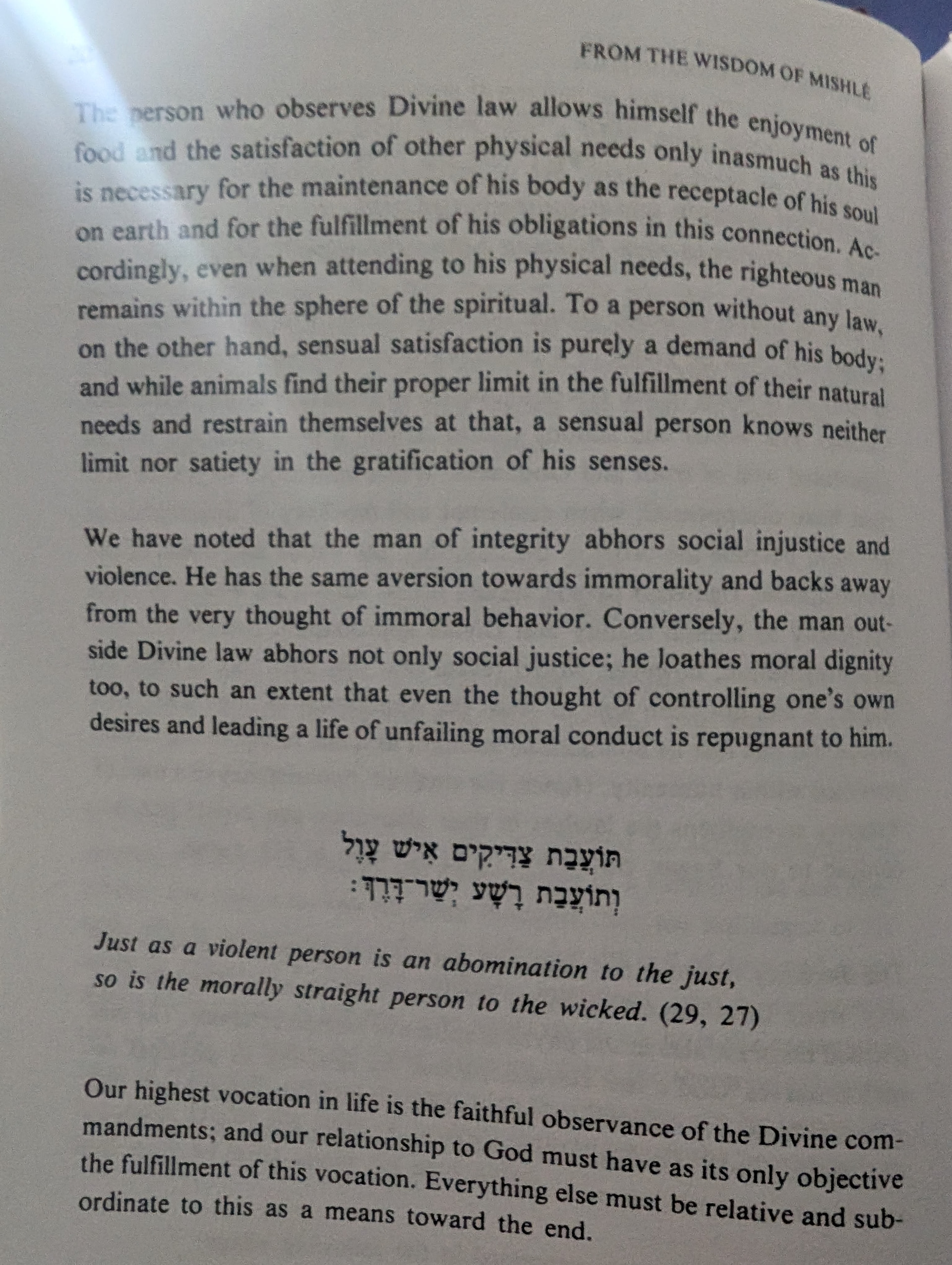
Here’s a picture from R Hirsch’s “From the Wisdom of Mishle”. I feel like it could have been directly lifted from Messilas Yesharim on Prishus? For me, they both hold that this world is good when being used to serve Hashem and bad when used for self-fulfillment?
2 Likes
I agree about that quote. Since Hirsch never wrote on Mishlei I have a feeling it’s pulled from what he wrote on Parshas Kedoshim which is the only place I recall him speaking this way. I’ll check and report back.
2 Likes
Nope. Not from Kedoshim. Here’s what he wrote there:
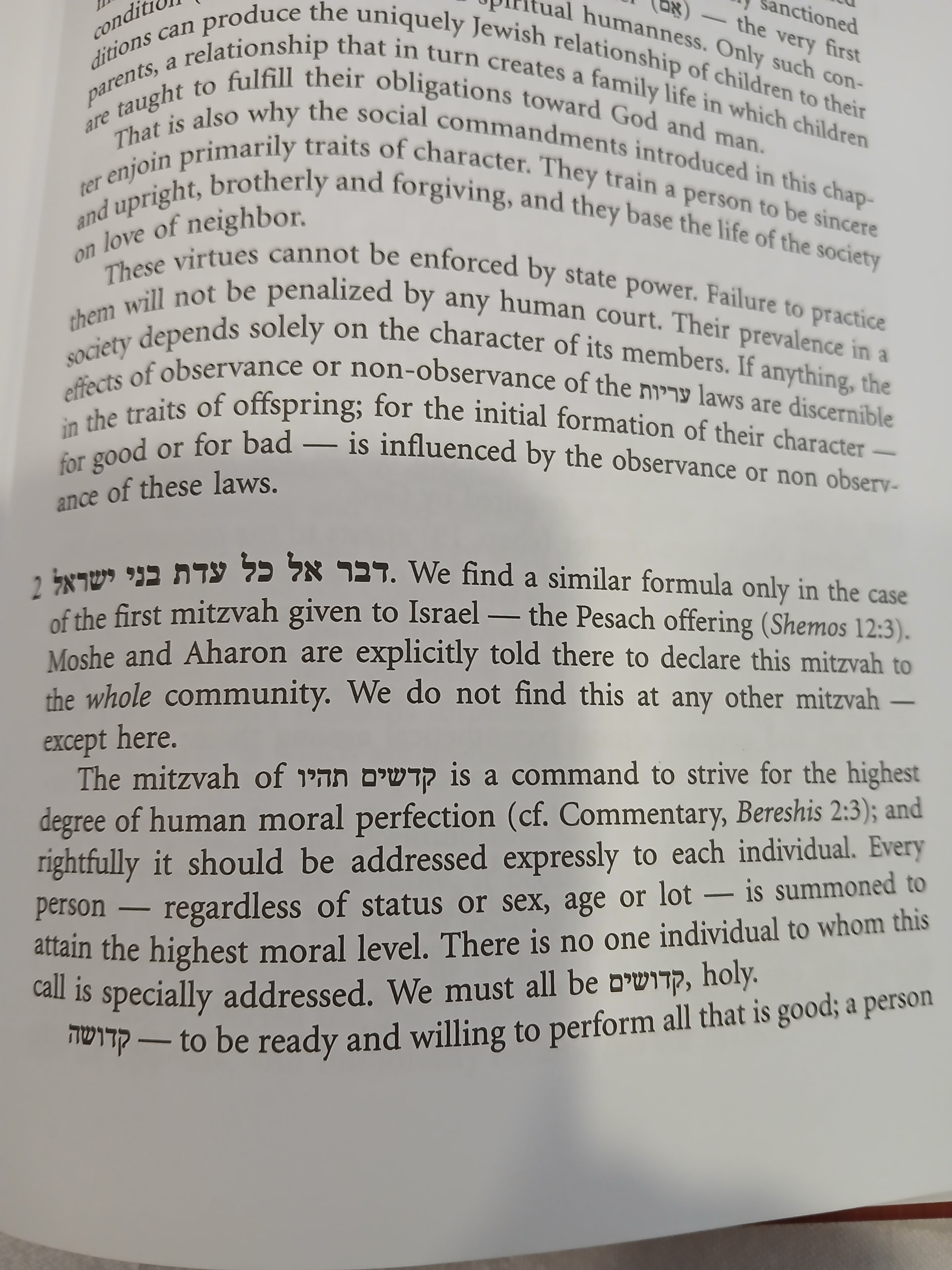
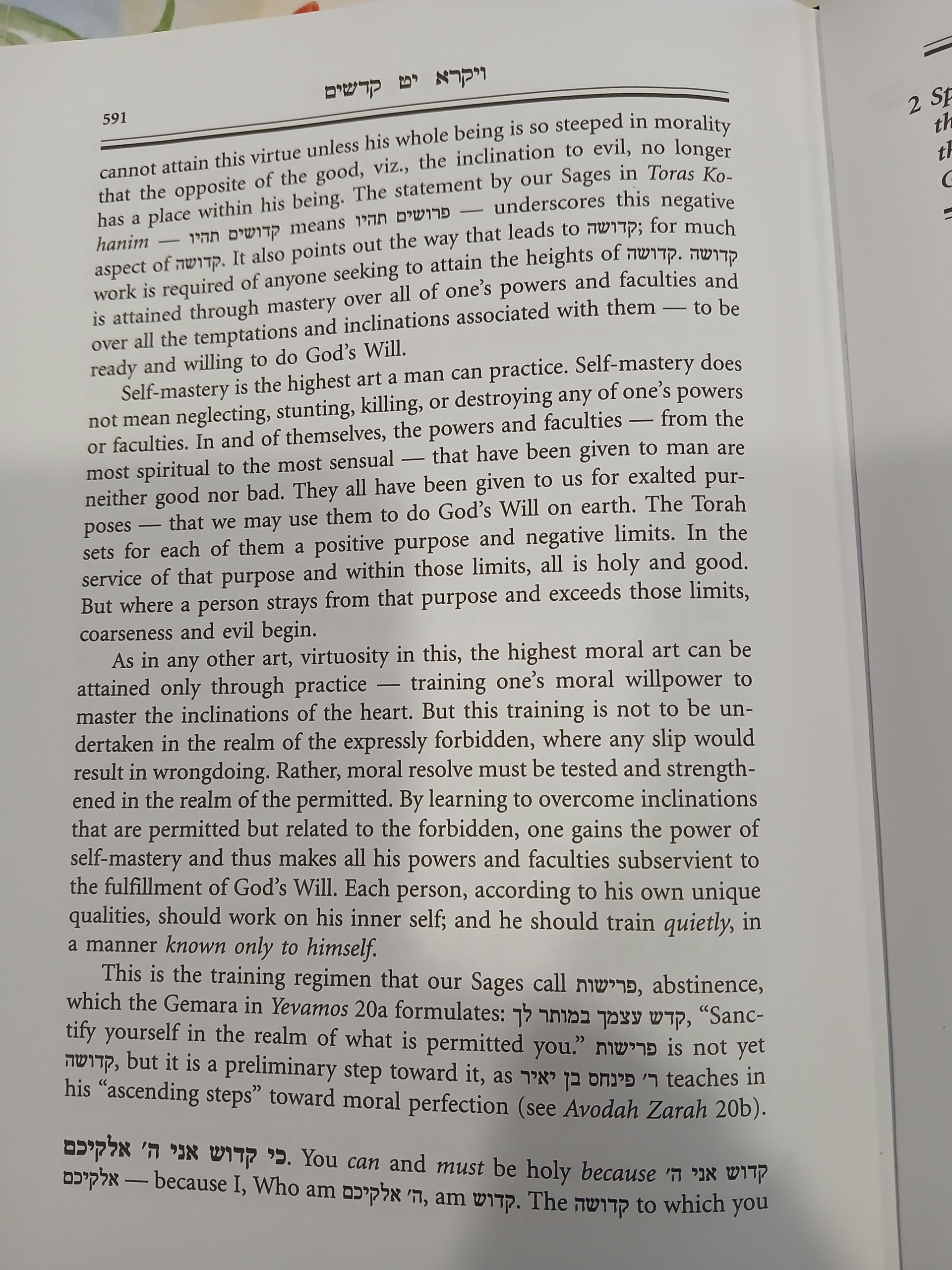
So I’m left pondering as I have in the past. This is not a theme in Hirsch’s writings and yet here it is.
2 Likes
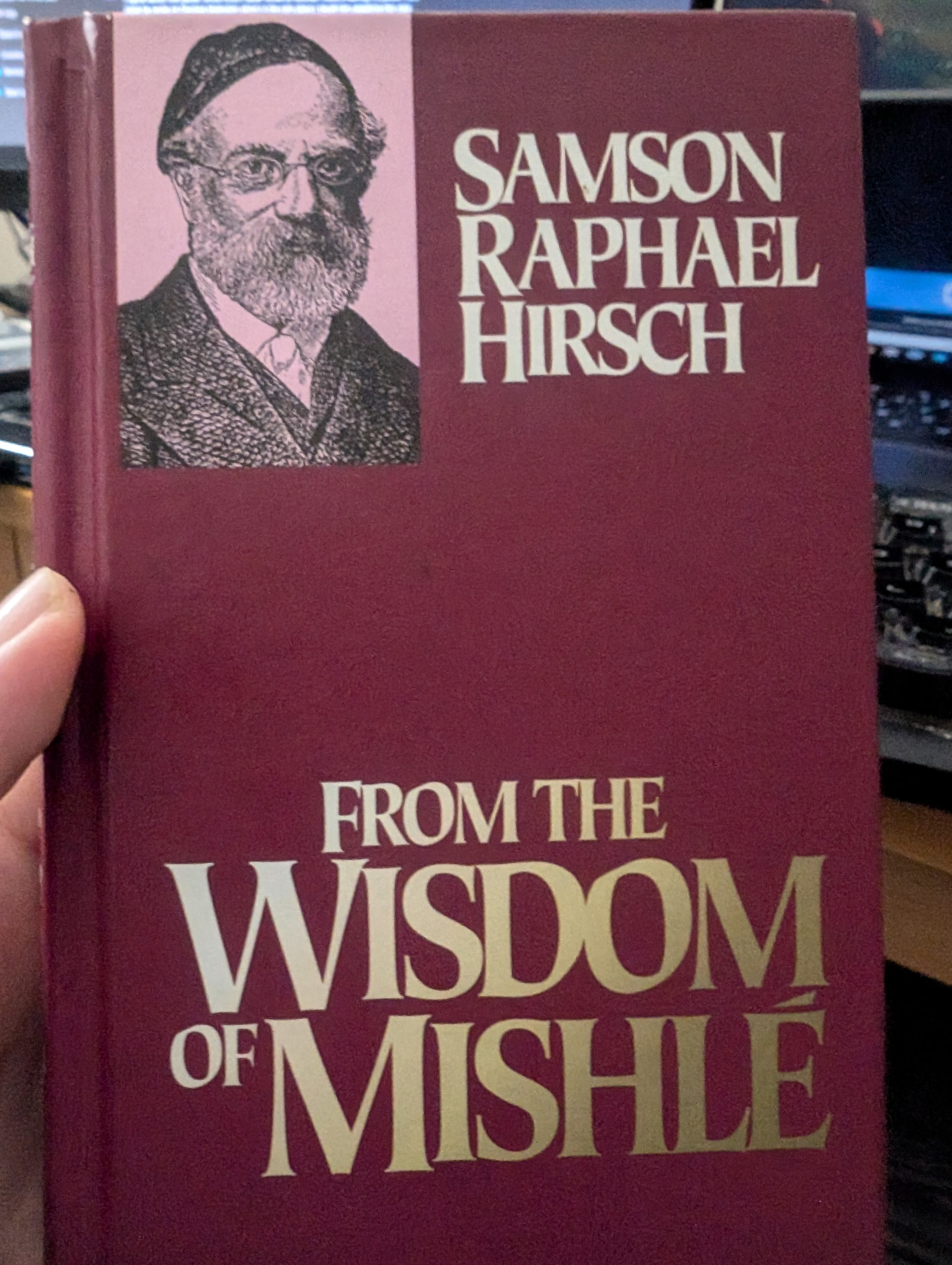
It’s from this volume. It’s a collection of essays on Mishle that were published in the New Yeshrun edited by his son. They are organized by theme and collect the verses from Mishle relevent to the theme with brief comments between the verses. This was from the essay on Righteous and Unrighteous.
Is this an essay I can find in collected writings? Or was the essay written by his son?
They were written by him. I don’t have the collected writings, so I’m not sure if it is there. It was printed in Yeshrun though, so in theory it should be in one of the latter volumes.
1 Like
I’m not sure why you are saying that this is not a theme in Hirsch’s writings. The idea that every aspect of life should be dedicated to the service of HKBH seems entirely consistent with our previous discussions of Hirschian thought.
What Hirsch writes here also does not appear to be the same as Ramchal’s position. Ramchal seems to describe the soul as not being naturally aligned with the physical world, whereas Hirsch is emphasizing that every dimension of earthly existence—and, most significantly, we ourselves—should be prepared and dedicated for complete devotion to HKBH and that is the definition of kedusha.
The focus on prishus is what makes me pause. As you wrote in your second paragraph, Hirsch wouldn’t emphasize the soul not belonging on this earth as the Ramchal does.
And yet there’s קדושים תהיו. It seems the Torah is saying “be careful. It’s a tightrope and you can fall and not uplift but be dragged down.” So therefore קדש את עצמך במותר לך.
And interestingly Hirsch quotes the same source as the Ramchal, רב פנחס בן יאיר.
First פרישות then קדושה.
1 Like
I would also add that Hirschian perisha and kedusha imply the existence of דברים המותרים. When perishus/kedusha, and/or the general outlook is taken to the extreme, where nothing is reshus, and everything is either a must-do or a no-no, much if not all of the sensitivity and decision-making is lost; what should have been, and perhaps started off as, as conscious choices become rote issurim, ready for their kosherization/work-around, as seen, sadly, all around us and in every ad.
1 Like
In a very “Hirschian” way, Rav Hutner told a talmid who was entering the work place , and thought he was having a “yerida”, “On the contrary, picture a pot of water boiling on the fire. You can’t really tell how much is in the pot since its actively boiling. When you remove it from the fire and it settles, then you see how much there is.
Likewise, when you are in the Bais Medrash (one can substitute a shule with a meaningful davening) you are on the “fire” we don’t really know how much Torah you have. Now, you are leaving the “fire” now you can show what you are really made of!”
5 Likes
Chazal say that in the generation of Dovid Hamelech they were TALMIDEI CHACHAMIM but since there was lashon harah and machlokes?
They fell in battle.
But the generation of Achav were IDOL WORSHIPERS, but because they were free of machlokes and were united?
They were victorious in battle!
No less an advocate of Torah learning than Rav Chaim Shmulevitz summed it up…
“Its mind boggling…
Machlokes is worse than the sin of avoda zora!”
2 Likes
Chukim: The Ultimate Relationship Builders
Para Aduma is seen by Jewish tradition as the paradigm of a chok, a decree of the Torah that is beyond human comprehension. Another example of a chok is shaatnez, wearing a garment containing a mixture of wool and linen (Vayikra, 19:19). There Rashi comments,” A decree of the King for which there is no rationale [which man can see]”.
We may have assumed that it would be inappropriate to even attempt to understand the reason behind, or the message of, a chok. Rambam, however, tells us differently.
“Even though all the chukim of the Torah are decrees … it is correct to contemplate them and to offer reasons whenever possible.” (Hilchos Temurah, 4:13)
It would also seem natural to see the observance of a chok as an expression of yiras Hashem, fear of G-d, as opposed to ahavas Hashem, love of G-d.
“It’s a decree from the King. We observe it because “He said so”.
I would like to offer an alternate approach.
It’s striking that the chok of shaatnez immediately follows “V’ahavta le’rayacha kamocha”, “Love your fellow as yourself”. This mitzvah is seen as the paradigm of an ethical obligation, perhaps the opposite of a chok.
Why would the Torah put these mitzvos back to back?
Hillel (Shabbos, 31A) paraphrases the commandment of “V’ahavta le’rayacha kamocha” by saying, “What is hateful to your friend, do not do to others”. Rashi there offers a very novel interpretation. Who is the “reah”, the “friend” that Hillel is referring to? And who should we love as ourselves?
Hashem!
Rashi cites a verse in Mishlei (27:10) that refers to Hashem as “reah”, “friend”. And according to this Rashi, the famous mitzvah to “love your friend as yourself” includes loving Hashem, by following all of His Mitzvos.
Based on this Rashi I would suggest that the chok of shaatnez is preceded by the Mitzvah to love Hashem in order to stress that the observance of a chok should also be an expression of ahavas Hashem, love of Hashem.
We can illustrate this idea by reflecting on human relationships. No one should consider marrying someone whom they never understand. At the same time, we all know that due to the nature of men and women, there are times when one spouse will just not “get it”, will not understand why something is important to the other.
But this very lack of understanding is a great opportunity to show a deep love and concern for the other. It gives the opportunity to say, (or maybe better, just think!) “To be honest, I can’t figure out why this is important to you!
But because it is important to you, it’s important to me!
Transferring this to our relationship with Hashem?
Most of the time we can readily understand on some level why He wants us to do a particular mitzvah. A chok, however, gives us the opportunity to say, “I love You so much, Hashem, that the fact that I don’t understand You is not relevant.
It’s important to me because it’s important to You”!
However, there’s an even deeper and more meaningful expression of love when not understanding the other. “Because it’s important to you, I will not only do it, but…
I am committed to trying harder to understand you and to understand why this is important to you”.
Transferred again to our relationship to Hashem, we can better appreciate the Rambam’s mandate to attempt to understand, on whatever level possible, the meaning of a chok.
It’s an expression of Ahavas Hashem!
And we now have another reminder of the Mitzvah of Ahavas Hashem…
Our shaatnez label!
2 Likes
It’s amazing how perhaps the greatest scientist of our generation is in sync with Peor!
“The cult of Peor is an illustration of the type of Darwinism that glories in man’s descent to the level of the beast, where, stripping himself of his Divinely-given nobility, he comes to regard himself as merely a highly-developed animal”
Rav Hirsch Bamidbar 25:3
On humans and our place in the world
"I believe the simplest explanation is, there is no G-d. No one created the universe and no one directs our fate.
We are just an advanced breed of monkeys on a minor planet of a very average star.
But we can understand the universe. That makes us something very special."
Stephen Hawking
1 Like
Re Kovna Kollel
In Shemesh Marpe (P 265) there are letters from Rav Yitzchok Elchanon Spector,
Rav of Kovna, and Rav Itzel Blazer (One of THE giants of the Mussar Movement.
Both wrote on behalf of the Kovna Kollel, thanking Rav Hirsch profusely for his past assitance in raising funds in Frankfurt and requesting further help. RH evidently wrote a very strong personal letter on behalf of the Kollel.
And the awe and respect that these two giants show for Rav Hirsch is very striking.
1 Like