Is the hashkafah of R' Avigdor Miller uniquely aligned with TIDE?

AI summary of WhatsApp discussion:

The original claim was that R’ Avigdor Miller, despite being broadly anti-TIDE, shared two incidental points of affinity with TIDE: concern for the morality of general society, and willingness to engage science and history in hashkafic discourse. The challenge raised was that concern for morality is not a meaningful criterion of TIDE affinity, since virtually any ideologue — including religious terrorists — claims moral motivation sincerely. The response clarified that the claim was never that RAM was TIDE, only that these two specific tendencies appear in him and are notably absent from much of contemporary right-wing Orthodoxy. Critics further argued that RAM’s specific recorded statements and political associations were disqualifying on their own terms, not merely a matter of hashkafic disagreement.

1 Like

Thanks for starting the thread Tamar.

To answer the question, I humbly can’t say with certainty that Rabbi Miller’s Hashkafa uniquely aligns with TIDE. But I also can’t say with certainty that his Hashkafa does not align with TIDE.

In certain ways it does, and in certain ways it does not. It all comes back to how we define TIDE to begin with.

Honestly see no affinities whatsoever other than perhaps their possessing a hashkafa, period.

1 Like

I did find this reminiscent of R’Hirsch’s position (and that of the Geonim, Rambam, and likely majority of Rishonim) that Chazal’s knowledge of science was based on that of their time. Though overall doesn’t seem like he was a TIDE proponent whatsoever.

1 Like

Something that I found very comforting about this blog post: YGB - יג"ב: Toras Avigdor Junior Vayigash. Is that it reaffirmed what I was sure to be true, namely that the R Miller pamphlets are not a particularly accurate representation of R Miller’s thoughts. While I still have hashgafic differences with him, it is good to know that someone who was steeped in Torah as he was didn’t actually hold all of the views attributed to him in the pamphlets.

Rav Avigdor Miller on Gaining Yiras Shomayim Through Science

Q:

What do you say about having encyclopedias in your home?

A:

It depends what they’re used for. If you use it, let’s say, as a pillow underneath your head…

Some encyclopedias are not beneficial to have in your house.

Now, I want to explain something to you. It’s a subject of limudei chol. I personally think limudei chol are a good thing if it’s done in a kosher way. Because limudi chol leads you to yiras Hashem if it’s done right.

And that’s why limudi chol in general would be very good. You know, in Frankfurt am Main, they taught limudei chol in the gymnasium of the frum Jews. And a man who went there told me once that he learned more yiras Shamayim from his science teacher there than he learned from his rebbe, because the science teacher utilized all the limudim to talk about yiras Shamayim.

It’s possible for a teacher to inject now and then certain thoughts in the minds of talmidim, that’ll give them more benefit than what they heard in the Mesivta, when the rebbe was saying shiurim and halachos. The rebbe is busy saying pilpul shiurim; he wouldn’t bother talking about yiras Shamayim. So all you have is a little mussar seder maybe. But if you have a science teacher in the yeshiva who knows what he’s doing, he can train the boys to yiras Shamayim with the science. It’s possible.

Because there’s so much yiras Shamayim in the world—you know there’s no fact in the world that’s as obvious as the fact that the world was created by a Borei Chochom. Wherever you look, if you’re able to see it, you’ll recognize the yad Hashem on all sides.

Therefore, if you are a responsible person—you’re learned already, you know mussar, you learn halachos—and you want an encyclopedia in order to use it to help other people become frum by the information that you might pick up, go ahead and do it. Otherwise, forget about it. Because you’re not capable of dealing with the apikorsus in these books.

You have to be trained. All the books are full of sheker. All the goyim are full of sheker. Their religions are sheker. Their science is sheker. Take it from me. Absolutely all sheker! But many things there, if you’re looking for chochmah by the umos ha’olam you can find some. יש חכמה באומות העולם – There is chochma in the umos ha’olam. It doesn’t mean everything is chochmah. There’s shtus too, mountains of shtus, but there’s some chochmah here and there.

If you’re capable of distinguishing, then it’s alright. But most people shouldn’t bother bringing any other books in their houses because they’re not capable. And children will read them and it’ll make a wrong impression on them.

And so it’s only if you’re capable. And that’s why I say it depends for whom. Not for everybody. For capable people, yes.

A man once brought me some books to show me. So I said, “Give them to me.” He shouldn’t have them. I should have them. So I put them in my beis hakiseh. I keep them there. I get benefit out of them; but he wouldn’t get any benefit from them. So I said, “Give it to me and I’ll use them.”

October 1996

Do you know anyone who would enjoy & grow from our emails? Send them this link!

I would like to give to Toras Avigdor
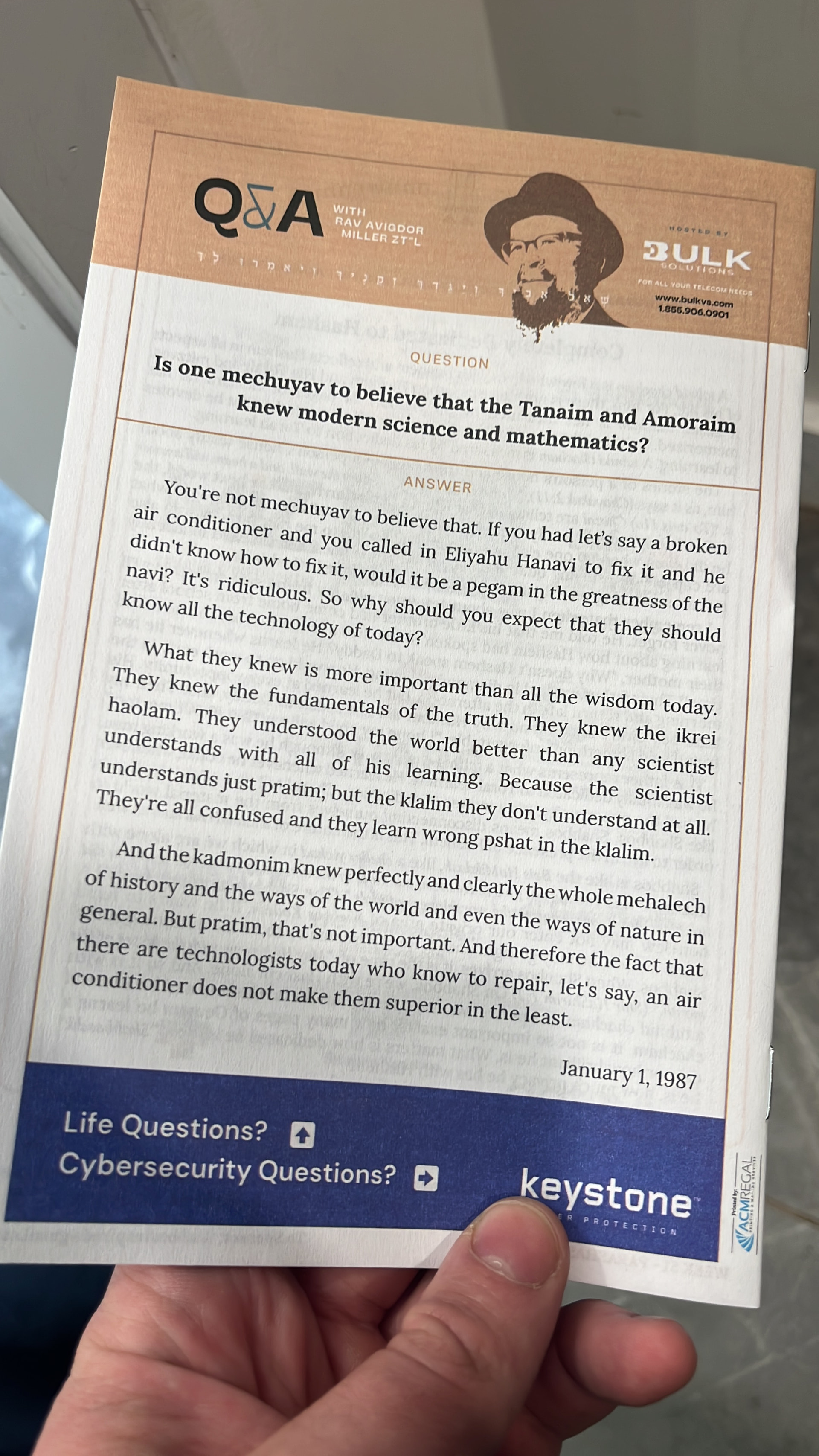
Some of these points shade into what I believe is a major divide between haredi and more left-leaning segments of Orthodoxy, namely, the extent of knowledge and trust extended to the “laity,” and, therefore, expected by it.

I chuckled upon seeing the title of this thread. Perhaps the OP was not privy to the recording where RAM asked “the woman with the udders” to be silent. I am sorry for being crass. Having heard the recording myself, there is nothing that can be said to me that would allow me to shoehorn derech eretz into RAM’s approach, even if he were aligned on specific topics like general education (he was not).

morality of general society

Every popular Hashkafa is concerned with the morality of general society. Jumping up and down and declaring everything contemporary to be immoral, and “the old days” (which at any point always happen to be 50 years prior to the statement) to be “better” is the easiest way to do so, and is most certainly not TIDE.

willingness to engage science and history in hashkafic discourse

I think all segments of Klal Yisrael are willing to engage in this. RAM’s approach of proving God’s existence by declaring that the creation of the universe and everything therein is equivalent to “filling a bowl of ink, tipping it over, and it somehow spells your name” is both a logical fallacy and contraindicated by TIDE (which allows for candid and straightforward scientific analysis) and by Hirsch (who preferred to experience God’s existence instead of attempting to prove it).

Critics further argued that RAM’s specific recorded statements and political associations were disqualifying on their own terms, not merely a matter of hashkafic disagreement.

To quote Christoph Waltz: “THAT’S A BINGO!”

[This post was edited to correct an accidental ALL CAPS.]

I strongly agree with one caveat–unfortunately, not all segments of Orthodoxy are remotely willing [never mind able] to discourse on hashkafic and/or scientific subjects. Most charedi schools admit this proudly and openly. Today, discussing the Kuzari’s historical proof is considered by many tantamount to the “דרך החקירה,” of onteological proofs etc. which, ironically, the Kuzari so very much is not.

1 Like

What I meant was that I believe every segment of the Charedi world purports to have accounted for all matters of global morality and science. At least in my personal experience, none of them will ever utter the phrase “We don’t know."

For morality, as I wrote, "everything new is bad” and “something something Chasam Sofer”.

For science, “Chazal knew everything”, “nishtanu hatevaim”, “it’s an Agadditah”, and other apologetics.

At least in my personal experience, they seem to believe they have fully engaged with all these matters and believe that their “comfortable ghetto” approach is the most thorough approach.

1 Like

The question is how to engage the segment of Orthodoxy - which is quite, quite large - that feels fealty to RAM and will discredit any individuals - let alone movements - who reject RAM. This is one of the many pragmatic challenges we face.

1 Like

Did anyone suggest an anti-RAM plank be added to the guiding principles?

I am slightly confused.

Let us convey TIDE. If someone notices it’s eppis not quite RAM, then s/he deserves credit for using his/her brain. If someone else somehow cobbles together a synthesis, I will credit his/her creativity.

I don’t subscribe to the silly sophisticated sneers looking down on the ink and writing proof. Sorry. I find that kind intellectual haughtiness arrogant and tiresome.

Do you think there’s a connection between that position and tone?

I don’t want to suggest a causation but it’s not a connection I haven’t observed before.

If there is any desire for substantive discussion,it would revolve around whether the proper equivalency would be to a bowl of ink that is meant to spell a name when spilled.

I apologize for offending you. When people write anonymously (especially because I do not) I feel they have disassociated themselves from personal engagement with their interlocutors, and the conversation itself is less personal. Moreover, in this specific area I feel this is an affront to great Jewish thinkers from the Chovos HaLevavos down to my Rebbe, Rav Tzuriel zt"l, in his brilliant essay on emumah in Otzaros HaMussar. Nevertheless, I apologize.

Thank you, I appreciate that.